
Regional EV Charging Infrastructure Plan

You asked, we listened! After hearing strong desire from members of the Puget Sound REV Collaborative, a regional EV charging infrastructure plan is in the works for 2026.
The plan will address charging infrastructure for light-, medium-, and heavy-duty vehicles. By convening partners, building on existing data and resources, and emphasizing coordination, the plan will accelerate the region’s clean transportation efforts.
The final regional EV charging infrastructure plan, to be completed in 2026, will support local governments around the Puget Sound region to accelerate coordinated electric vehicle charging infrastructure development.
Your perspective—including needs, challenges, expertise, opportunities, and ideas—is essential to ensure the final regional plan is as useful as possible. Read on to learn more about the plan and how you can stay involved.
Plan Benefits
The plan will be a shared roadmap for expanding EV charging infrastructure across King, Kitsap, Pierce, and Snohomish Counties. It will provide coordinated, regionally consistent recommendations for where and how charging infrastructure should be installed to meet current and future needs for light-, medium-, and heavy-duty vehicles. The plan will translate existing data, best practices, and participant priorities into a single regional vision that supports well-placed, reliable, and accessible infrastructure.
The regional EV charging infrastructure plan will:
- Serve as a roadmap for coordination for charging infrastructure deployment across the region to encourage economies of scale and seamless regional connectivity.
- Clarify public-sector roles and responsibilities and how governments can complement private-sector investment.
- Identify priority areas and applications for charging infrastructure investments.
- Integrate equity and environmental justice through data-driven and community-informed site evaluation criteria and recommendations.
- Recommend strategies to reduce barriers related to zoning, permitting, building codes, accessibility, and operations and maintenance.
- Incorporate best practices for reliability, cost, utilization, and deployment speed.
- Recommend strategies to support workforce development and address supply chain constraints for charging infrastructure.
- Prepare jurisdictions to pursue competitive funding and grant opportunities.
Plan Partners
The plan’s development is being led by the Puget Sound Clean Air Agency with support from a consulting team, alongside partners from King, Kitsap, Pierce and Snohomish Counties, the Puget Sound Regional Council, and the Washington State Department of Commerce.
During the plan’s development, the project team will engage with partners including:
- City government staff
- Tribes
- Utilities
- Transit agencies
- Ports
- Community-based organizations
- Workforce entities
- Community-based organizations
- Rideshare drivers
- Potential charging infrastructure site hosts
- Equipment manufacturers
Key Plan Components
The Plan will feature detailed guidance for deploying charging across eight different light-, medium-, and heavy-duty vehicle charging use cases. Specifically, the Plan will contain:
- Modeled EV charging needs for each use case at the census tract level
- Site evaluation criteria to help planners select specific parcels suitable for charging
- Recommended roles, coordination, and partnerships to advance charging deployment in the region
- A summarized Regional Action Framework with specific and actionable steps for local governments
Plan Development Timeline
The plan’s development will occur throughout 2026, with work happening in phases.
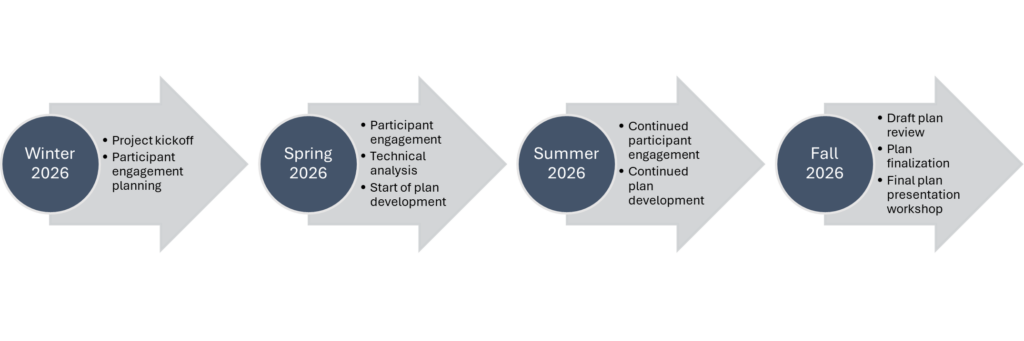
An important step in the plan’s development is hearing from partners like you to ensure the plan reflects the region’s diverse needs. Most engagement activities are taking place during the spring and summer of 2026, with participant input informing the scope and contents of the plan.
In fall of 2026, you can provide additional feedback on the draft plan through an online engagement hub. Sign up for email updates below to stay informed!
Stay in the Loop!
Sign up for the REV email list to receive updates about the regional EV charging infrastructure plan’s development and opportunities to get involved.
If you have questions about the plan, please contact us at PugetSoundREV@pscleanair.gov.